
Liguria, the Coast Between Worlds
Discover Liguria, where colourful coastal villages, dramatic cliffs, and timeless traditions meet the Mediterranean. Explore the charm of this extraordinary region, from Genoa to the Cinque Terre and beyond.
From Genoa to the Cinque Terre, a travel designer’s portrait of a region best understood through perspective, rhythm and local knowledge.
Liguria is often introduced through a handful of beautiful names: Portofino, Cinque Terre, Genoa. Each one carries its own mythology. Yet the real character of this region lies in the relationships between them — between city and village, mountain and sea, cultivated terraces and wild Mediterranean vegetation.
This is a coast that rarely unfolds in a straight line.
The Ligurian-born poet Eugenio Montale spent formative summers in Monterosso, and the landscape of the Cinque Terre entered deeply into his imagination. His image of the distant trembling of shards of sea is difficult to separate from this coastline, where the Mediterranean is never merely a background, but a presence glimpsed through branches, between houses and from paths suspended above the water.
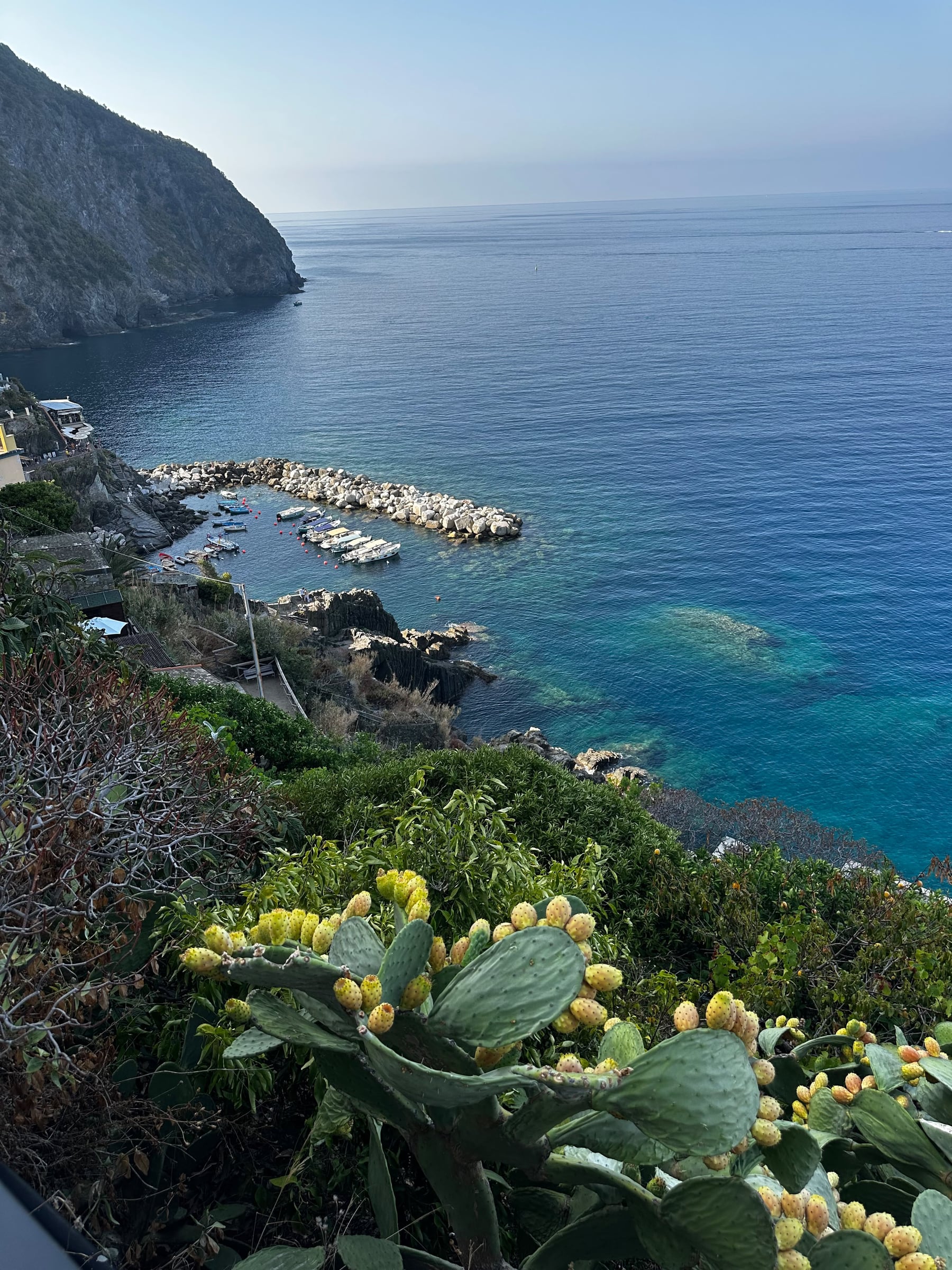
The land rises sharply from the water. Roads curve around promontories, paths climb above tiled roofs and vineyards occupy slopes that seem almost too steep to farm. From the sea, villages appear as small constellations of colour beneath green hills. From above, the perspective changes again: the coastline becomes an intricate sequence of bays, headlands and human settlements held between rock and water.
To travel well here is not simply to move from one famous place to another. It is to understand how the territory connects — and how the experience changes according to the season, the point of arrival, the weather, the sea and, above all, the traveller.
This is where thoughtful design begins.
Genoa, a City That Opens Outwards
Genoa is one of Italy’s great maritime cities, but it does not reveal itself at once. Its beauty is layered rather than immediately polished: noble palaces and narrow caruggi, grand façades and unexpected courtyards, the historic port and neighbourhoods climbing towards the hills.
The city rewards curiosity. A private guide can give coherence to its many identities — mercantile, aristocratic, seafaring and contemporary — while leaving room for the details that make Genoa memorable: dark slate, painted façades, glimpses of the harbour between buildings and the particular light of a city facing the Mediterranean.
Genoa is also an excellent beginning rather than merely a destination in itself. A stay here can become the centre of a broader journey through Liguria, with days shaped around the coast, its villages, gardens, food traditions and maritime culture. It can also open towards Piedmont, where the landscape, cuisine and wines create a compelling contrast with the sea.
The two regions meet more naturally than a map might suggest. Liguria looks outward across the Mediterranean; Piedmont turns towards vineyards, hills and the Alps. Experienced together, they offer two distinct expressions of northern Italy — one saline and vertical, the other earthy and expansive.
The important question is not how many places can be reached from Genoa. It is which combination will create the most meaningful journey for a particular traveller.
Along the Gulf of Tigullio
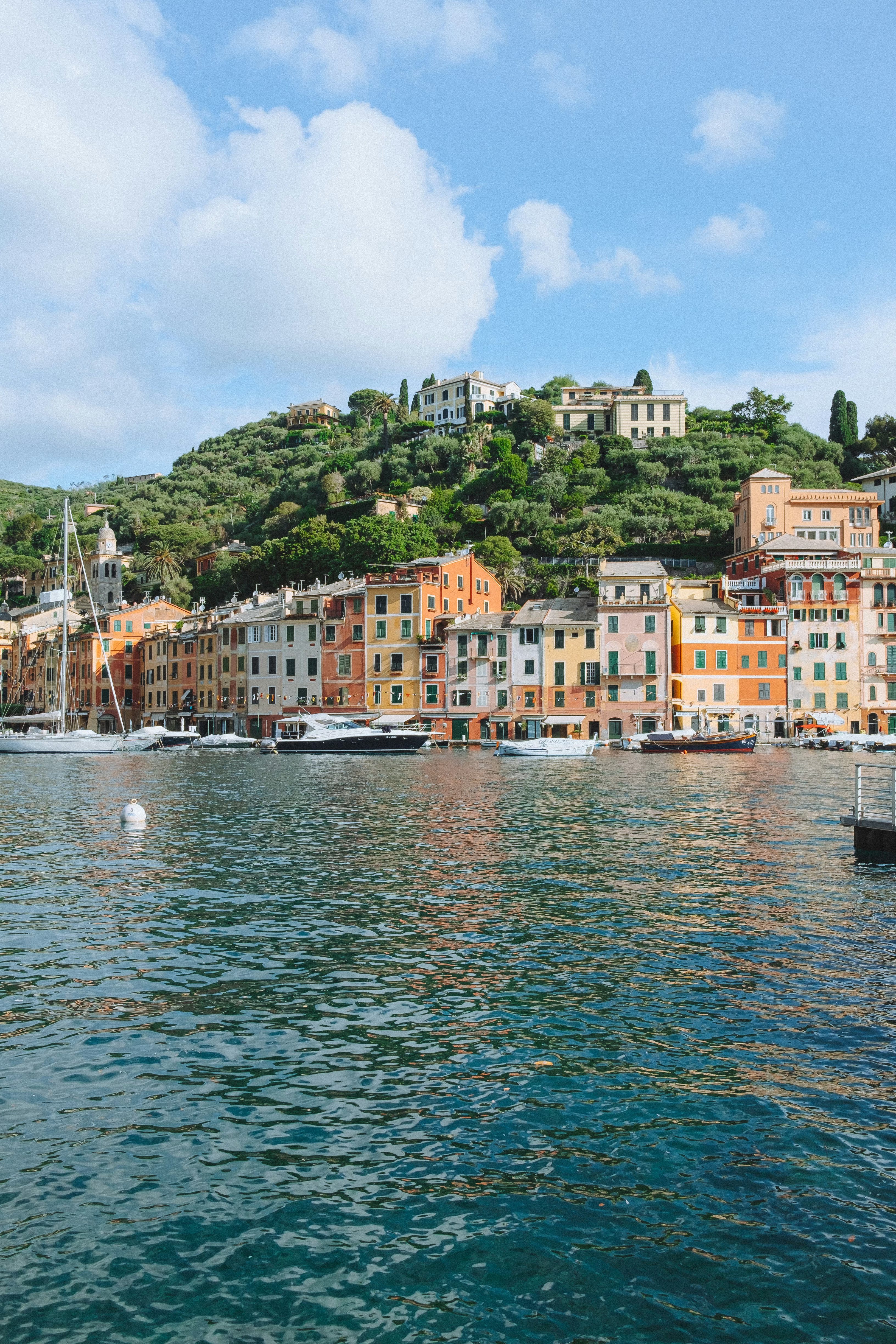
East of Genoa, the coast gathers around some of Liguria’s most recognisable names. Portofino is the icon: a small harbour framed by pastel buildings, wooded slopes and the deep green-blue of the sea. Its fame is undeniable, but its scale remains intimate. It is best understood not in isolation, but as part of a wider coastal landscape.
Santa Margherita Ligure brings the grace of a seaside town, with gardens, villas and a waterfront made for an unhurried walk.
Beyond its polished waterfront, the Portofino promontory shelters San Fruttuoso, a secluded bay reached only by sea or on foot. Here, a Benedictine abbey founded in the tenth century and later closely connected with the Doria family rises almost at the water’s edge, between wooded slopes and a small fishing settlement. Its church, cloisters, abbey rooms and historic burial place give the cove a rare sense that architecture, memory and landscape are inseparable. Whether approached across the water or discovered at the end of a path, San Fruttuoso feels less like a monument placed on the coast than a place born from it.
Rapallo has a more lived-in rhythm, combining an elegant promenade with the everyday energy of a Ligurian town. Camogli, on the Golfo Paradiso, tells another maritime story: tall painted houses, a long fishing tradition and a shoreline that changes character with the light.
These places can be combined in many ways, but they should not be treated as interchangeable stops. The pleasure may lie in approaching one village by water, walking part of the coast, lingering over lunch or simply allowing time for the harbour to become quiet again after its busiest hour.
The finest experience is not necessarily the fullest one.
What works beautifully for a couple interested in gardens and coastal walks may not suit a family travelling with young children, guests with limited mobility or travellers who want to spend most of the day on the water. A private journey must respond to those differences. The coast is the same; the way of entering it should be entirely personal.
Portovenere, the Threshold to Another Coast
Further east, Portovenere stands apart from the Gulf of Tigullio and deserves its own place in the story. Built along a dramatic edge of land near the Gulf of La Spezia, it has a more elemental atmosphere: stone, sea, wind and the dark outline of its church above the water.
It can act as a threshold between different Ligurian experiences. To one side are the maritime landscapes of the gulf; beyond lies the coast of the Cinque Terre. Depending on the journey, Portovenere may be a destination, a pause, an approach by boat or the moment when the geography of eastern Liguria suddenly becomes clear.
That sense of context matters. A place becomes richer when it is not presented as a solitary postcard, but as part of a landscape shaped by centuries of movement along the sea.
Five Villages, One Vertical Landscape
The Cinque Terre — Riomaggiore, Manarola, Corniglia, Vernazza and Monterosso al Mare — are five distinct villages, not a single attraction.
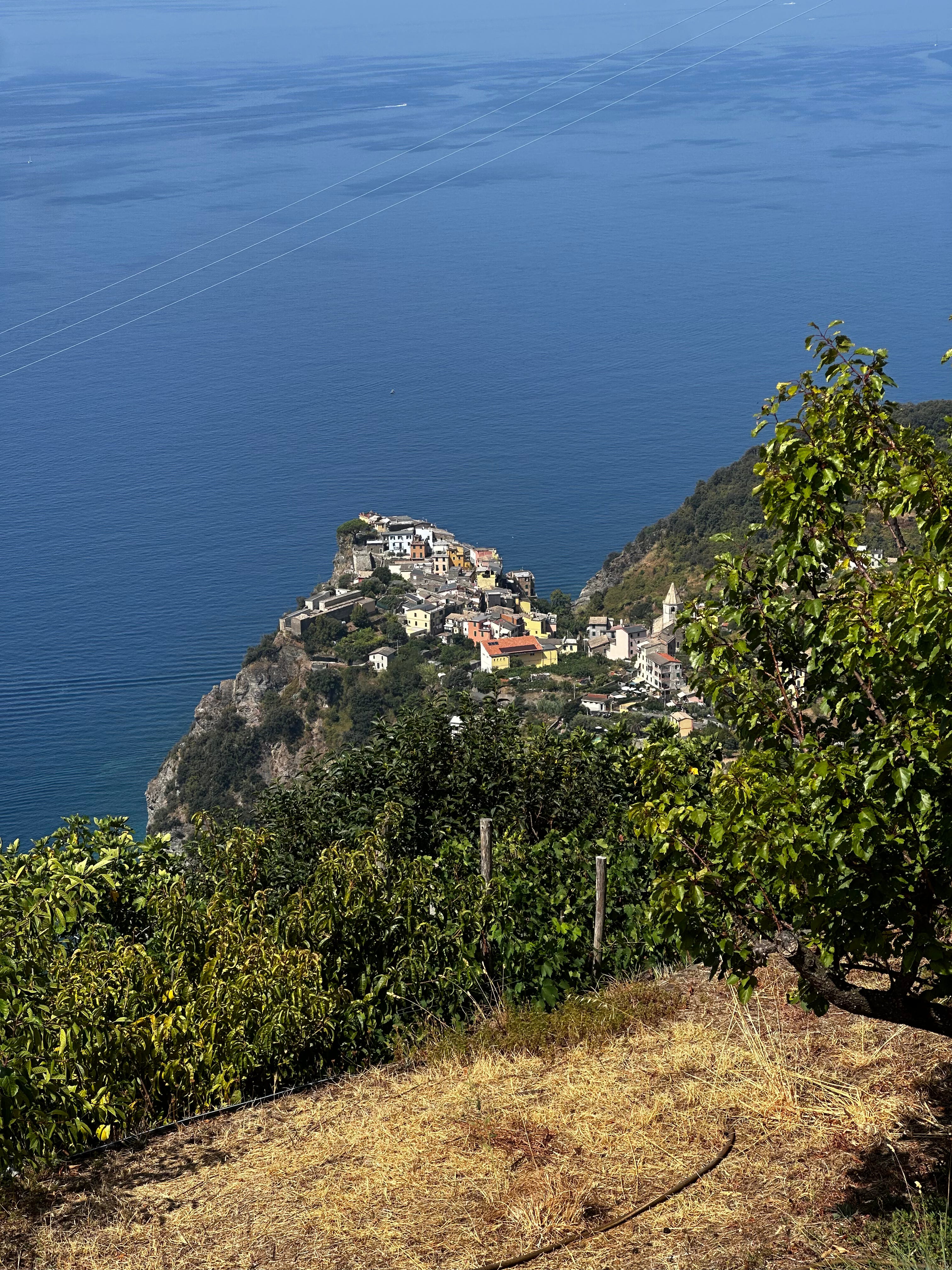
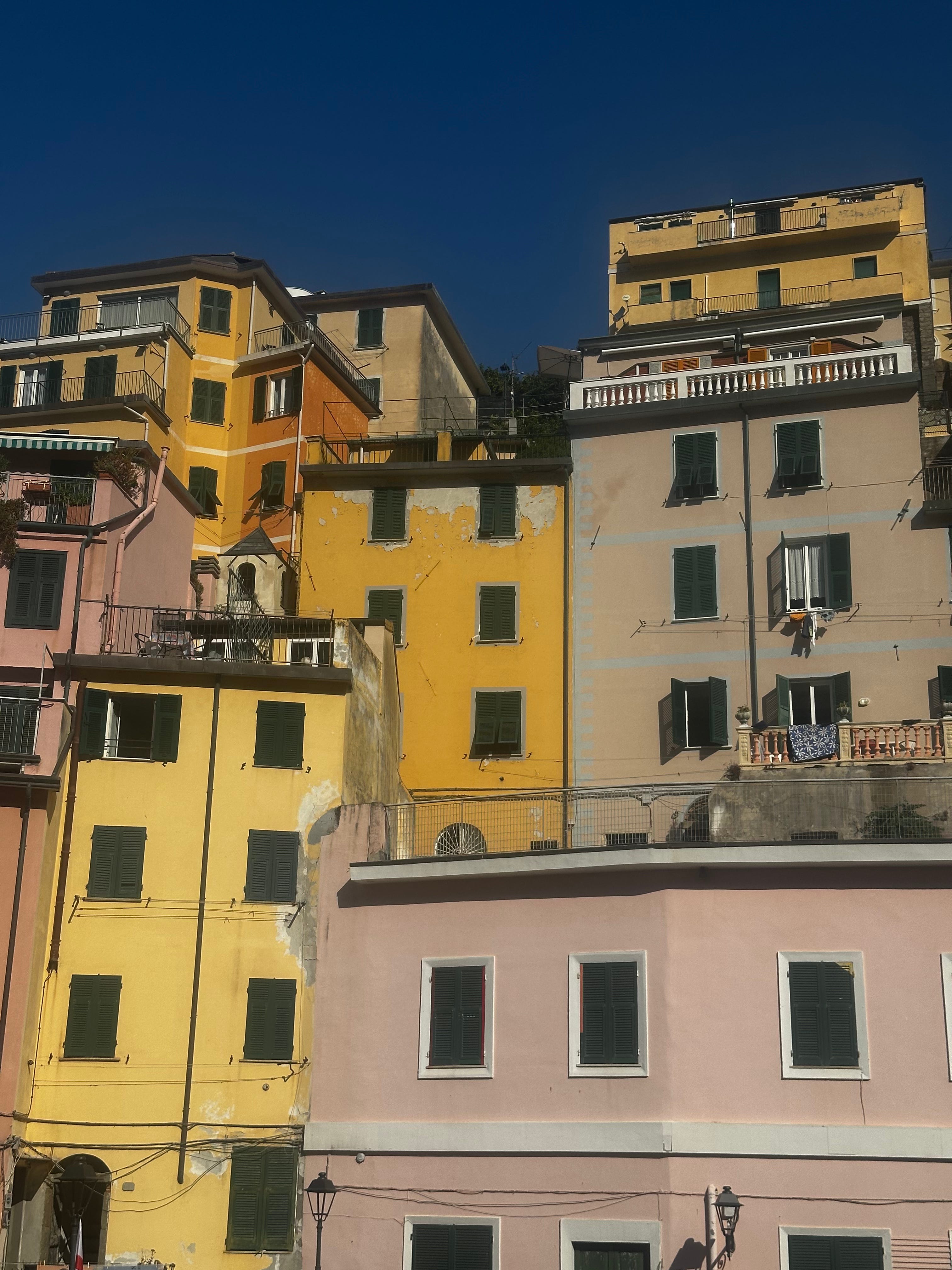
Each occupies a different relationship with the coast. Some seem to descend directly into the water; Corniglia sits above it, looking out from its higher position; Monterosso opens onto a broader shoreline; Vernazza gathers around its small natural harbour; Manarola and Riomaggiore rise through narrow folds in the terrain.
Their beauty is inseparable from the land behind them.
Above Manarola, the hillside village of Volastra offers a quieter perspective on the Cinque Terre. Surrounded by terraced vineyards and open views across the coastline, it is an ideal setting for wine tastings, moments of relaxation and experiences shaped around a gentler rhythm. Here, away from the livelier waterfront villages, travellers can slow down, appreciate the agricultural soul of the region and enjoy the landscape with the time and attention it deserves.
For generations, people cultivated these steep slopes by creating dry-stone terraces, transforming an almost vertical environment into vineyards, gardens and small agricultural plots. The result is not simply picturesque. It is a cultural landscape made through patience, labour and an extraordinary understanding of place.
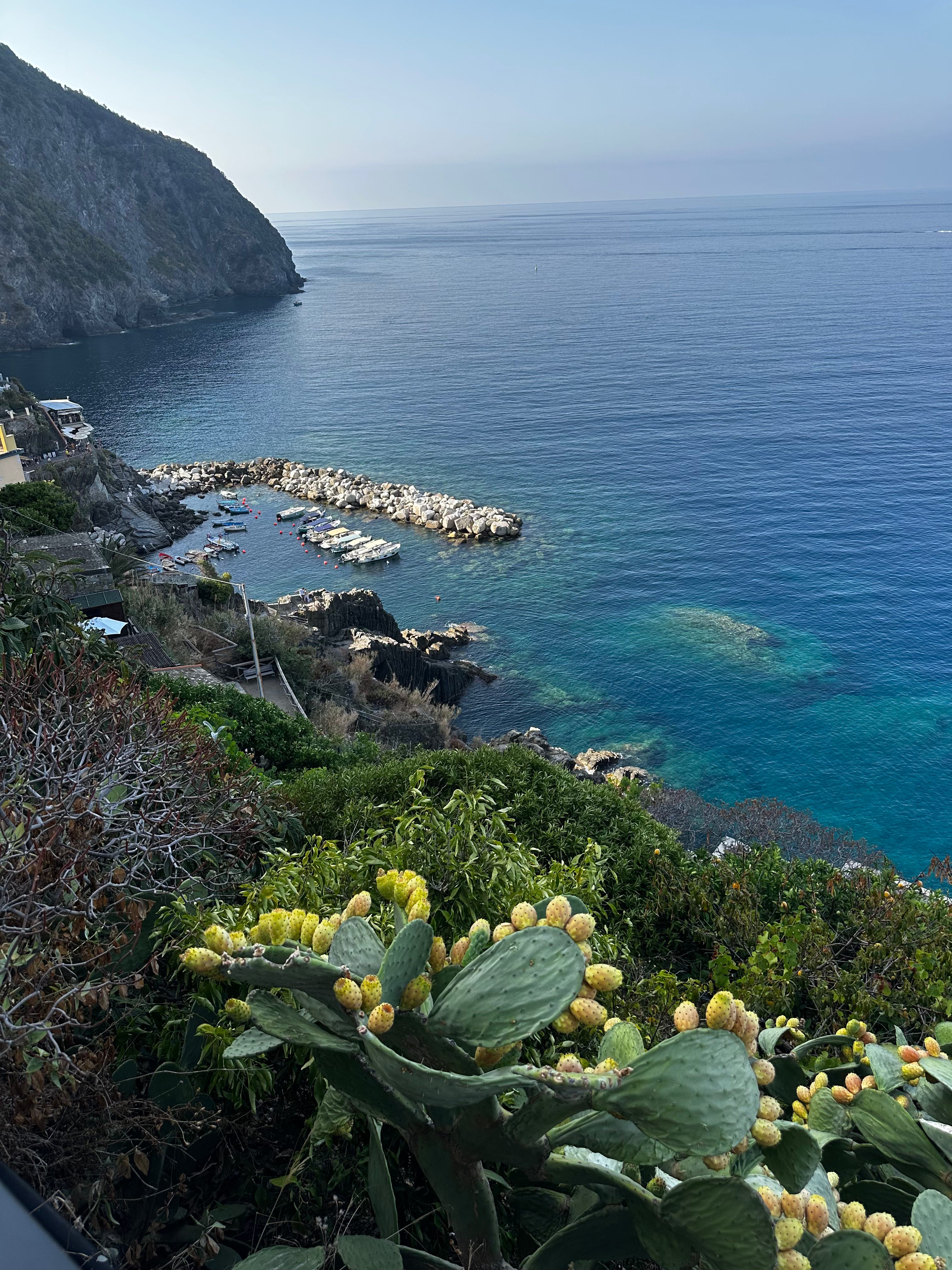
Vines grow where the mountain faces the sea. Mediterranean plants occupy every available margin. Wooded areas, rocky habitats, cultivated terraces and marine environments exist close together, giving this compact coastline a remarkable biodiversity. Looking at the Cinque Terre from a boat, one sees how improbable the villages appear. Looking down from a panoramic point above them, one understands the scale of the human effort that has shaped the slopes.
Both perspectives are essential. Neither tells the entire story alone.
Seeing the Cinque Terre Your Way
There is no single correct way to experience the Cinque Terre.
For some travellers, the experience begins as a private shore excursion from La Spezia or Portofino. For others, the villages are an extension from Tuscany, a natural stage when travelling south from northern Italy or part of a dedicated Ligurian holiday rather than something compressed into a single day.
The most suitable approach depends on much more than the place of departure. It depends on the traveller’s pace, comfort with walking, interest in wine and food, desire to spend time on the sea and tolerance for steps, slopes and changing conditions. A honeymoon should not feel like a family excursion; a relaxed cultural journey should not be designed like an active hiking holiday.
Local knowledge helps turn those preferences into the right shape of experience. Trusted local professionals can advise on the approach most suited to the guests, while we ensure that each element belongs within the journey as a whole. A day might include time on the water, a walk suited to the guests, an encounter with the agricultural landscape or a tasting in a setting where the view gives meaning to what is in the glass. From higher ground, it is possible to take in the sweep of the coast and understand the five villages as part of one connected environment. From the sea, the same landscape becomes theatrical: cliffs, terraces and coloured houses rising almost vertically from the water.
These are possibilities, not a formula.
The value of a tailor-made itinerary lies precisely in deciding what to include, what to leave out and in which order the day should breathe. That work remains behind the scenes. The traveller should experience ease, not the complexity required to create it.
A Coast for More Than One Season
Liguria is strongly associated with summer, yet its character changes beautifully across the year.
Spring brings new colour to the slopes and a freshness that invites walking. Summer places the sea at the centre of the experience and makes the rhythm of each day especially important. Autumn draws attention towards vineyards, food and the cultivated landscape. Even the quieter months can reveal a more private coast, when the famous views are no longer competing with the urgency of the high season.
No season is simply better than another. Each requires a different design.
Opening times, sea conditions, path access, local events and the natural rhythm of the villages all influence what is possible and what is pleasurable. A journey created with territorial knowledge can adapt to those realities while preserving the spirit of the trip.
This flexibility is particularly important on a coast where land and water are so closely connected. A beautiful plan must also be a responsive one.
The Luxury of Making It Feel Simple
In a complex landscape, true luxury is often invisible.
It is a private chauffeured car or van arriving when it should. A knowledgeable guide who can make a city or village feel legible. Carefully arranged boat experiences, well-judged walking and advance admission where it is useful. It is the reassurance that each element has been considered as part of the whole rather than booked in isolation.
At Zest Italy Tours, we design private journeys around the people who will actually take them. We consider where they are arriving from, how they like to travel, how active they wish to be and what they hope to remember. Then we bring together the services the journey requires — transport, guides, tickets and local experiences — with one coherent rhythm.
We know when two places belong naturally in the same day and when they deserve to remain separate. We know that a celebrated view can be extraordinary, but that timing, access and perspective may determine whether it becomes a genuine memory or only another photograph. We also know that the most valuable details are often the ones a traveller never needs to think about.
That knowledge is part of our craft. It cannot be reduced to a checklist, because no two journeys should be identical.
The Liguria We Want Travellers to Remember
I want travellers to remember Liguria not only as a collection of beautiful names, but as a landscape with depth.
I want them to feel Genoa opening slowly around them; to see how Portofino belongs to a wider constellation of coastal towns; to understand why Portovenere has its own presence; and to recognise the Cinque Terre as five communities held within an extraordinary vertical environment.
I want them to taste the connection between the vineyards and the slopes, to notice the biodiversity around the terraces and to experience the coast from the perspective that suits them — perhaps from a path, perhaps from a panoramic table above the sea, perhaps from the deck of a boat.
Most of all, I want the journey to feel personal.
Liguria asks for attention. It rewards travellers who look beyond the postcard, who allow the landscape to set the pace and who understand that the art of travel is not to see everything, but to see the right things well.
That is the Liguria we design: connected, considered and shaped around the person who is discovering it.
Explore Our Tours in Cinque Terre & Liguria
To explore Genoa, the Ligurian coast, the Cinque Terre and journeys connecting Liguria with Piedmont through a private itinerary created around your interests and pace, contact Zest Italy Tours at info@zestitalytours.com.