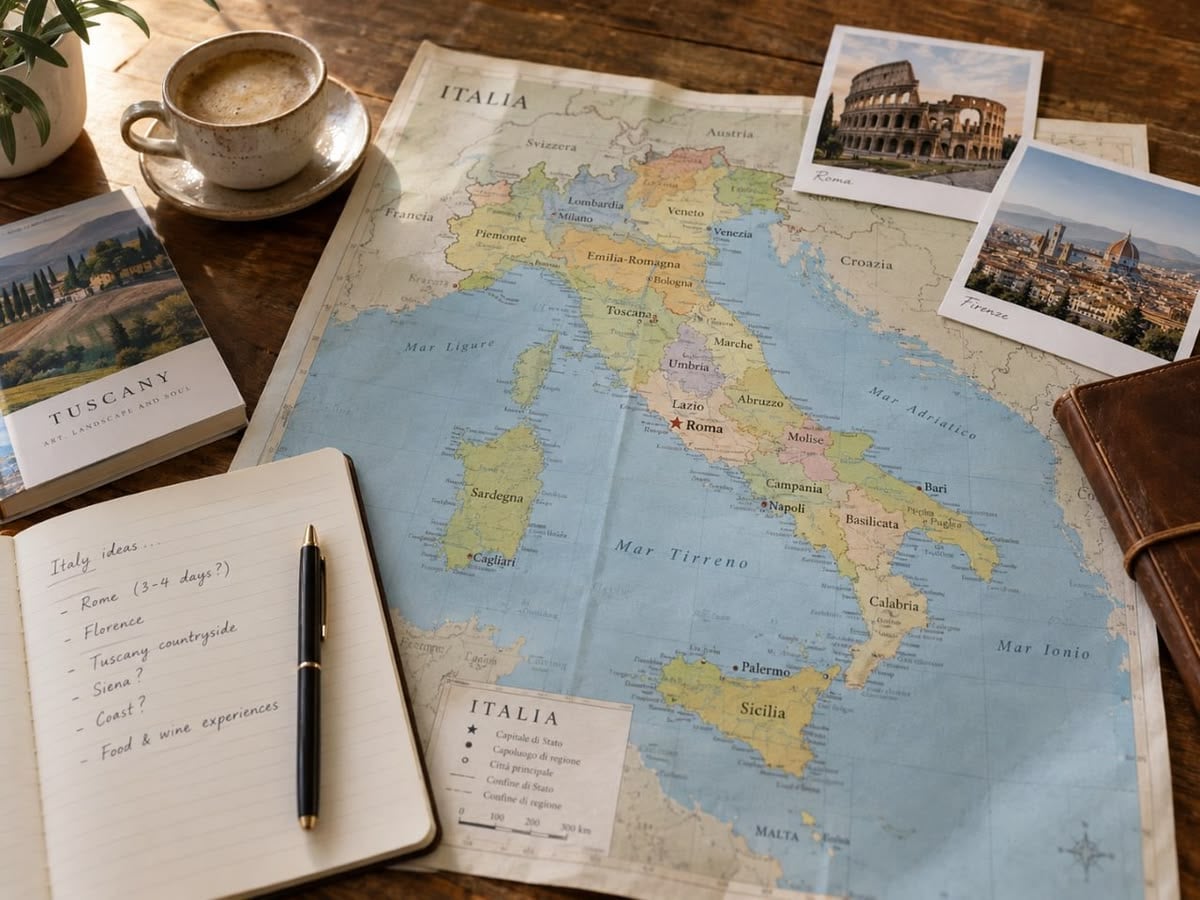


How to Plan a Private Trip to Italy: A Personal Guide to Creating the Right Journey
Planning a private trip to Italy is about more than choosing beautiful destinations. It means finding the right rhythm, connecting regions intelligently and knowing when local expertise, private services and carefully chosen experiences can transform the journey. This guide explains how to create an Italian itinerary that feels personal, coherent and entirely your own.
Italy often looks easier to plan than it really is.
On a map, the distances seem manageable. High-speed trains connect the main cities, and destinations such as Rome, Florence, Venice, Tuscany and the Amalfi Coast appear to fit naturally into the same trip. Then the practical questions begin. How many places can you visit without spending most of your time moving from one hotel to another? Which regions can be combined sensibly? When is a train the best option, and when is a private driver more useful? Which experiences need to be arranged well in advance? And, perhaps most importantly, how do you create a journey that feels personal rather than like a list of famous places connected by reservations? After years of designing private journeys in Italy, I have learned that the best itineraries do not begin with a list of bookings. They begin with a conversation.
What Does a Private Trip to Italy Really Mean?
The word “private” can mean different things to different travelers. For some, it means adding a private guide to a holiday they have already organized. For others, it means a completely tailor-made journey, with carefully selected hotels, private transportation, expert guides, special access and local assistance throughout the trip. Private travel does not necessarily mean that every single element must be exclusive.
A private guide can make a visit to the Vatican Museums or the Roman Forum more personal and meaningful. A private driver may be invaluable for a day in Tuscany, while a high-speed train may be the most practical way to travel from Rome to Florence.
The important point is that the journey is designed around the travelers: their interests, their pace, their mobility and the way they want to experience Italy. This is what makes a trip genuinely tailor-made.
Start with the Reason for the Journey
Before choosing destinations, I always think it is useful to understand why the travelers are coming to Italy.
Is it their first visit? Are they returning to places they already know? Are they celebrating an anniversary, traveling with children or planning a multigenerational holiday? Are they mainly interested in art and history, or would they prefer to combine culture with food, wine, nature and time outdoors? These details influence every decision that follows.
A first-time visitor may naturally want to include Rome, Florence and Venice. Someone returning to Italy might prefer to combine one of these cities with Umbria, Piedmont, Puglia or Sicily. A family may need shorter visits and a more flexible schedule. A couple celebrating a special occasion may prefer fewer destinations, better chosen, with more time to enjoy each one.
The itinerary should reflect the purpose of the trip. Otherwise, even beautiful places can begin to feel disconnected.
How Many Destinations Should You Include?
One of the most difficult decisions when planning a private trip to Italy is knowing what not to add. Italy is relatively compact, but travel times are not always obvious. A journey from one hotel to another includes packing, checking out, reaching the station or meeting point, traveling, collecting luggage and checking in again. A travel day can easily take several hours, even when the distance itself does not look significant. The number of destinations should depend on the length of the trip, the regions involved and the travelers’ preferred rhythm. Three destinations experienced properly are often more rewarding than five visited in a hurry. That does not mean that every journey has to be slow. It simply means that each movement should have a reason. Sometimes a transfer can become part of the experience. The route from Rome to Florence might include a stop in Orvieto. A journey into Tuscany could include a hill town, a winery or an architectural site. A transfer through central Italy might become an opportunity to discover a place that would otherwise not have been included.
When the route is designed carefully, a travel day does not necessarily feel like time lost.
Give Each Place Enough Time
The number of nights does not always correspond to the amount of time travelers will actually have.
Three nights usually mean two full days, particularly when arrival and departure are involved. An overnight flight can also make the first day less productive than expected. Rome needs time because its history is spread across the entire city. Florence is compact, but its museums, gardens and surrounding countryside offer very different experiences. Venice is a good example. A short stop may allow travelers to see St. Mark’s Square and the main landmarks, but staying an extra night creates time to experience the city beyond the busiest hours, explore its quieter neighborhoods and appreciate its atmosphere at a more natural pace. It may also open the possibility of adding a carefully chosen day escape into the Veneto, such as Verona, the Prosecco Hills or the Palladian villas, creating a broader and more complete experience of the region without changing hotels again. Tuscany is not one destination but a region, and the Amalfi Coast requires flexibility because of traffic, road conditions and weather.
I also believe that the rhythm of the day matters enormously. A morning at the Vatican followed by the Colosseum, an evening food tour and another early start the next day can work very well when the timing, distances and transitions are carefully coordinated. The question is not how many experiences are included, but how they are connected.
A well-designed itinerary can combine several meaningful visits in the same day while still allowing enough time for transfers, pauses and unexpected moments. A cultural morning, a relaxed lunch, an afternoon experience and an evening food tour may create a rich and satisfying day when the rhythm is planned around the travelers rather than simply filling every available hour.
Luxury is not about doing less. It is about making every element feel considered, comfortable and worthwhile.
Choose the Season for the Journey You Want
There is no single perfect month to visit Italy.
Spring and early autumn are popular because temperatures are generally comfortable, but these are also highly requested periods. The best hotels, guides and special experiences may need to be confirmed many months in advance.
Summer can be wonderful for the coast and the islands, while the main art cities may be hot and busy. Winter offers a quieter atmosphere and can be particularly rewarding for travelers interested in art, architecture, food and local life.
Seasonality also changes from one region to another. A month that works well for Rome and Florence may not offer the conditions someone expects for a boat experience on the Amalfi Coast. Harvest periods, religious celebrations and local events can also affect availability.
The most useful question is not simply, “When is the best time to visit Italy?” It is, “Which season is best suited to the journey these travelers want to experience?” This is one of the first decisions we consider when designing a private itinerary. The answer depends on the destinations, the experiences involved and the rhythm of the journey—not only on the weather.
Train, Private Transfer or Chauffeured Vehicle?
Transportation is the invisible structure of an Italian itinerary.
When it is planned well, travelers barely notice it. When it is not, it can become one of the defining elements of the day.
High-speed trains are often ideal between Rome, Florence, Venice, Bologna, Milan and Naples. They connect central stations and can be quicker than traveling by road.
A private transfer is not automatically the better choice simply because it is private. In the countryside, a private driver can make it possible to combine several places and experiences without turning the day into a sequence of complicated connections, as in a private day trip to Castel Gandolfo and the Roman countryside.
The decision changes when travelers have considerable luggage, limited mobility, young children, a rural accommodation or several stops to make along the way. A private vehicle is particularly useful in Tuscany, Umbria, Puglia and other areas where experiences are spread across the countryside.
On the Amalfi Coast, the right solution may involve a combination of private cars, boats and ferries. In Venice, water taxis are often part of the logistics. In the countryside, a driver can make the day considerably easier. Good planning does not force one type of transport into every part of the itinerary. It uses each option where it works best.
Where a Private Guide Makes a Difference
Not every place needs to be visited with a private guide. But in certain situations, the right guide changes the entire experience.
The Vatican Museums can otherwise feel overwhelming. The Roman Forum is difficult to understand without some context. Our private Rome in One Day experience is designed around this type of careful planning. At Pompeii, the remains become much more vivid when someone can explain how people lived and moved through the ancient city.
In Florence, an expert guide can transform a museum visit into a story about patronage, power and artistic change rather than a succession of famous works. A private guide can adapt the experience according to the travelers in front of them. They can change the level of detail, respond to questions, involve children or focus on a particular artistic interest. The value is not simply in receiving more information. It is in understanding the relationships between the places, people and stories that make Italy what it is.
Combine Italy’s Icons with Its Living Culture
For a first visit, the famous landmarks matter. The Colosseum, the Sistine Chapel, Michelangelo’s David and the canals of Venice are not famous by accident. I do not believe that an itinerary becomes more authentic simply by avoiding everything that is well known.
The real opportunity is to place these icons within a wider experience.
A visit to Renaissance art may be followed by time with an artisan. An archaeological site could lead to a family-run restaurant or a local food tradition. A private transfer through the countryside might include a historic village, a producer or a landscape that explains something about the region. Authenticity is not about finding a place that no one else has ever visited.
It is about context, human connection and the quality of the encounter. This is also the idea behind our Zest Collection of private and less publicly accessible experiences, created for travelers who want to encounter Italy through its living traditions, artisans, architecture and places that are not always visible through standard booking channels.
Leave Space for the Journey
Private travel should create freedom, not replace one rigid schedule with another.
Some of the most enjoyable moments may come from having enough time to return to a neighborhood, linger over lunch, sit on a hotel terrace or change the rhythm of an afternoon.
Leaving space is not a lack of planning. It is part of good planning.
It also allows the itinerary to respond to reality. Weather, traffic, opening arrangements and local conditions can change. A journey with no flexibility can quickly become stressful.
Private services are most valuable where they add expertise, comfort or adaptability. Elsewhere, a train journey, a shared cooking class or an unplanned afternoon may be exactly the right choice.
Why Work with an Italy-Based Travel Specialist?
The value of a local specialist is not simply knowing which places are beautiful. It is understanding how those places work together in practice.
An Italy-based travel designer can assess whether a route is realistic, identify the services that require advance planning and coordinate hotels, guides, drivers, tickets and special experiences across different regions. This becomes especially important when travelers are interested in private openings, specialist guides or places that are not available through a normal online booking calendar.
At Zest Italy Tours, we begin with a conversation before we begin with an itinerary. We want to understand not only what travelers would like to see, but how they want to feel during the journey: curious rather than rushed, looked after rather than managed, and free to enjoy Italy without carrying the weight of its logistics. This becomes especially important when travelers are interested in private openings in Italy, specialist guides or places that are not available through a normal online booking calendar
A Private Italy Trip That Feels Like Your Own
Italy does not need to be made extraordinary. Its art, landscapes, history, food and daily life already offer more than any itinerary can contain.
The work lies in creating the right conditions to experience it well. That means choosing destinations that belong together, allowing enough time, using private services where they genuinely add value and leaving space for the journey to breathe. Behind a seamless trip there may be months of research, coordination and careful planning. The travelers, however, should experience only clarity and ease. The best private Italy itinerary does not show how complicated it was to create. It simply feels as though Italy has unfolded in exactly the right order.
Frequently Asked Questions
How far in advance should I plan a private trip to Italy?
For spring, summer and early autumn, I generally recommend beginning the planning process 9–12 months in advance. More time may be necessary if the journey includes several regions, highly requested hotels, private guides or special access experiences.
How many destinations can I visit in two weeks in Italy?
A two-week trip can comfortably include three or four well-connected bases. The right number depends on the regions involved and the preferred pace of travel.
Is it better to travel around Italy by train or with a private driver?
It depends on the route. Trains are often ideal between major cities, while private drivers are particularly useful in the countryside, along the coast and when travelers want to include meaningful stops between destinations.
What is included in a private Italy trip?
A tailor-made journey may include accommodations, private transfers, chauffeur services, licensed guides, tickets, private tours, special access and local experiences. The structure is developed according to the travelers’ priorities.
Can a private Italy itinerary include lesser-known places?
Yes. The most interesting journeys often combine Italy’s essential landmarks with places and experiences connected to local culture, craftsmanship, food, history and landscape.
Does Zest Italy Tours plan trips throughout Italy?
Yes. Zest Italy Tours designs private, tailor-made journeys throughout Italy, including Rome, Florence, Venice, Tuscany, Umbria, Puglia, Sicily, the Amalfi Coast and other regions.